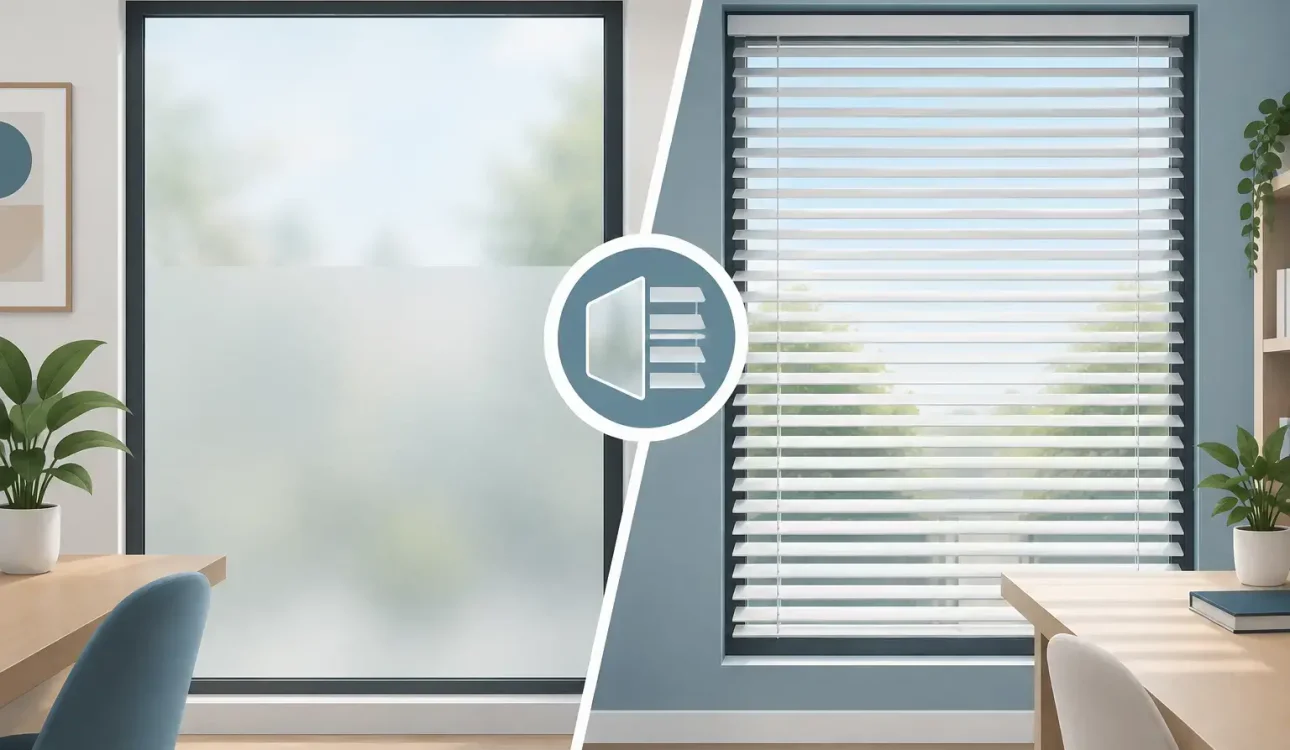
A street-facing bathroom, a home office opposite another building, and a glass-walled meeting room all present the same question: frosted film vs blinds – which gives you privacy without making the room feel closed in? The right answer depends on whether you need permanent coverage, adjustable light, heat control, or a stronger design statement. For many homes and workplaces, the best choice is less about decoration and more about how the glass needs to perform every day.
Frosted Film vs Blinds: The Core Difference
Frosted window film is an adhesive or static-cling material professionally applied directly to existing glass. It diffuses visibility through the window while allowing natural daylight to pass through. Blinds are a movable window covering, usually mounted above or within the window frame, that uses slats, fabric, or panels to control visibility and light.
That basic difference affects nearly everything else. Frosted film gives consistent privacy at all times. It does not need to be raised, tilted, cleaned between slats, or adjusted before a video call. Blinds offer flexibility: open them fully for an unobstructed view, partially tilt them for filtered light, or close them for privacy.
Neither solution is automatically better. A bathroom window with a direct line of sight from neighboring homes has different needs from a living room that overlooks a garden or a conference room that must switch between open collaboration and confidential meetings.
Privacy: Permanent Coverage or Adjustable Control?
Frosted film is often the stronger option where privacy must be reliable around the clock. Once installed, it obscures the view from both sides of the treated glass, making it well suited to bathrooms, shower screens, front-door sidelights, ground-floor windows, interior office partitions, and clinic rooms.
The level of privacy can vary. A full frosted finish creates an even, translucent appearance, while decorative patterns, gradients, and partial-height designs can cover only the areas that need screening. This is especially useful when you want privacy from passersby while keeping an upper section clear for daylight or an outward view.
Blinds provide privacy only when they are closed or angled appropriately. This is not necessarily a disadvantage. In bedrooms and living areas, the ability to open a window treatment completely can be valuable. But it does introduce a daily trade-off: when the blinds are open for light, the room may also be exposed to outside views.
For offices, this distinction matters more than it first appears. Frosted film on internal glass can create permanent visual separation without turning a workplace into a series of enclosed rooms. Blinds may be a better fit for executive offices or meeting rooms where visibility needs to change throughout the day.
Consider nighttime privacy carefully
At night, interior lights make it easier to see into a room through uncovered glass. Frosted film continues to provide obscurity after dark. Blinds can do the same when closed, but open slats or small gaps can still allow silhouettes and light to show through.
If dependable nighttime privacy is the priority, frosted film is usually the more straightforward choice.
Natural Light and the View Outside
Frosted film preserves daylight but deliberately softens the view. Rather than seeing a sharp image through the window, you get bright, diffused light that reduces visual exposure. This can make compact rooms feel more open than they would with opaque curtains or fully closed blinds.
The compromise is clear: you cannot keep a meaningful outside view through a fully frosted section. If the window frames a city skyline, landscaping, or an open outdoor area you enjoy, covering the entire pane may feel restrictive. A partial film design can solve this by frosting the lower half or the most exposed section of glass.
Blinds are better for windows where the view is worth preserving. When open, they leave the glass clear. When partially tilted, they can direct and soften sunlight while retaining some visibility outdoors. Horizontal blinds, vertical blinds, roller blinds, and cellular shades all handle light differently, so the final result depends on the specific product.
For spaces that need daylight without distraction, frosted film has a distinct advantage. It is a popular choice for home offices because it removes the visual activity outside the window while avoiding the dim, enclosed feeling of a fully covered blind.
Heat, Glare, and UV Performance
Standard frosted film is designed primarily for privacy and appearance. It may diffuse harsh daylight, but it should not automatically be treated as a high-performance solar control product. If strong sun, glare, and hot glass are major concerns, ask for a film engineered specifically for solar rejection, UV reduction, or both.
This is where an expert recommendation matters. Window orientation, glass type, room use, and the amount of direct sunlight all affect which film will perform best. In high-rise apartments, sun-facing rooms, retail storefronts, and offices with extensive glazing, a privacy film may need to be paired with solar film or replaced by a dual-purpose option.
Blinds can reduce glare effectively when closed, particularly blackout and sunscreen styles. However, heat may already be entering through the glass before indoor blinds block the light. Some window treatments insulate better than others, but their solar performance is not identical.
A window film sits directly on the glass, allowing it to address solar energy at the window itself. For spaces with ongoing afternoon glare or uncomfortable heat near the glass, this can make a noticeable difference in day-to-day comfort. The best approach is often to separate the issues: choose frosted film for privacy, solar film for sun control, and blinds only where adjustable shading or a fully open view is essential.
Maintenance and Durability
Frosted film is one of the lowest-maintenance privacy solutions available. After professional installation and proper curing, it can be cleaned with a soft cloth and a mild, non-abrasive cleaner. There are no cords, slats, tracks, or fabric panels collecting dust.
Quality matters. Low-grade films may discolor, shrink, lift at the edges, or show uneven application over time. Professional installation also helps avoid trapped debris, bubbles, alignment issues, and premature failure. A properly selected premium film should look clean and intentional rather than like a temporary cover-up.
Blinds require more regular care. Slatted blinds collect dust on both sides of each slat, while fabric shades can retain dust, odors, and stains. Cords, mechanisms, and mounts may also need repair over time. In kitchens, bathrooms, or humid spaces, materials must be selected carefully to prevent warping, mildew, or corrosion.
For rental properties or situations where you expect to change your look frequently, blinds can be easier to replace. For owners who want a long-lasting, fuss-free privacy upgrade with minimal visual bulk, frosted film is often more practical.
Style and Space Planning
Blinds bring texture and depth to a room. Wood-look blinds can add warmth, roller shades can feel minimal and modern, and blackout options can support a darker sleep environment. They are a visible furnishing choice and can become part of the interior design.
Frosted film is more integrated. It follows the glass line, keeps window frames uncluttered, and works particularly well in modern apartments, commercial interiors, bathrooms, and compact rooms. Decorative film can also introduce subtle patterns, stripes, geometric designs, or branding without requiring new glass.
This makes film especially effective for glass partitions. Instead of replacing clear panels, a tailored frosted design can create privacy bands, define rooms, display a company identity, or meet practical visibility requirements. The result is clean and permanent-looking without the cost and disruption of renovation.
When Frosted Film Is the Better Choice
Choose frosted film when you need consistent privacy, want to preserve daylight, prefer a low-maintenance finish, or want a clean solution that does not take up room around the window. It is particularly suited to bathrooms, street-facing windows, glass doors, interior partitions, and overlooked apartment windows.
It is also the better choice when blinds would become inconvenient. A narrow bathroom window behind a vanity, a fixed office partition, or a tall pane beside a staircase does not always allow for easy adjustment or cleaning. Film keeps those awkward windows useful without adding hardware.
When Blinds Are the Better Choice
Choose blinds when controlling the view is as important as controlling privacy. Bedrooms, living rooms, and scenic windows often benefit from the ability to open the treatment fully. Blinds also make sense when you need room-darkening performance or want fabric, color, and texture to play a larger role in the interior.
For many properties, the strongest answer is a combination. Use frosted film where exposure is constant, then use blinds in rooms where you want adjustable shade and an open view. This avoids forcing one product to solve every window challenge.
At ShieldShade International, the focus is on matching film performance to the way a space is actually used. Before choosing, stand in the room at different times of day, check sightlines from nearby buildings and walkways, and decide whether your priority is privacy, light, heat reduction, or flexibility. That small assessment leads to a window solution that continues to work long after installation day.