A clear window can make a room feel bright and open – right up until the moment you realize your neighbors, nearby offices, or people across the street can see straight in. That is usually when the search for the best window film for privacy becomes less about decor and more about comfort, control, and peace of mind.
Privacy film is one of the simplest upgrades you can make to existing glass. It does not require replacing windows, and it can solve several problems at once, including visibility, glare, and in some cases heat and UV exposure. But not every film creates privacy in the same way. The best choice depends on when you need privacy, how much light you want to keep, and whether the space is residential or commercial.
What makes the best window film for privacy?
The short answer is that there is no single film that is best for every window. A bathroom, a street-facing living room, a glass meeting room, and a storefront all need different levels of screening, light control, and appearance.
A good privacy film should first do its core job well – reduce unwanted visibility without making the space feel dark or closed off unless that is the goal. Beyond that, the better options also hold up over time, resist peeling or discoloration, and suit the local climate. In hot, bright environments, performance matters just as much as appearance. A film that gives privacy but traps too much heat or fails early under strong sun is not a smart long-term choice.
This is why product category matters more than marketing labels. When people ask for privacy film, they are often talking about one of four types: frosted film, reflective film, blackout film, or decorative film. Each has clear strengths, and each comes with trade-offs.
Frosted film – the most reliable all-day privacy option
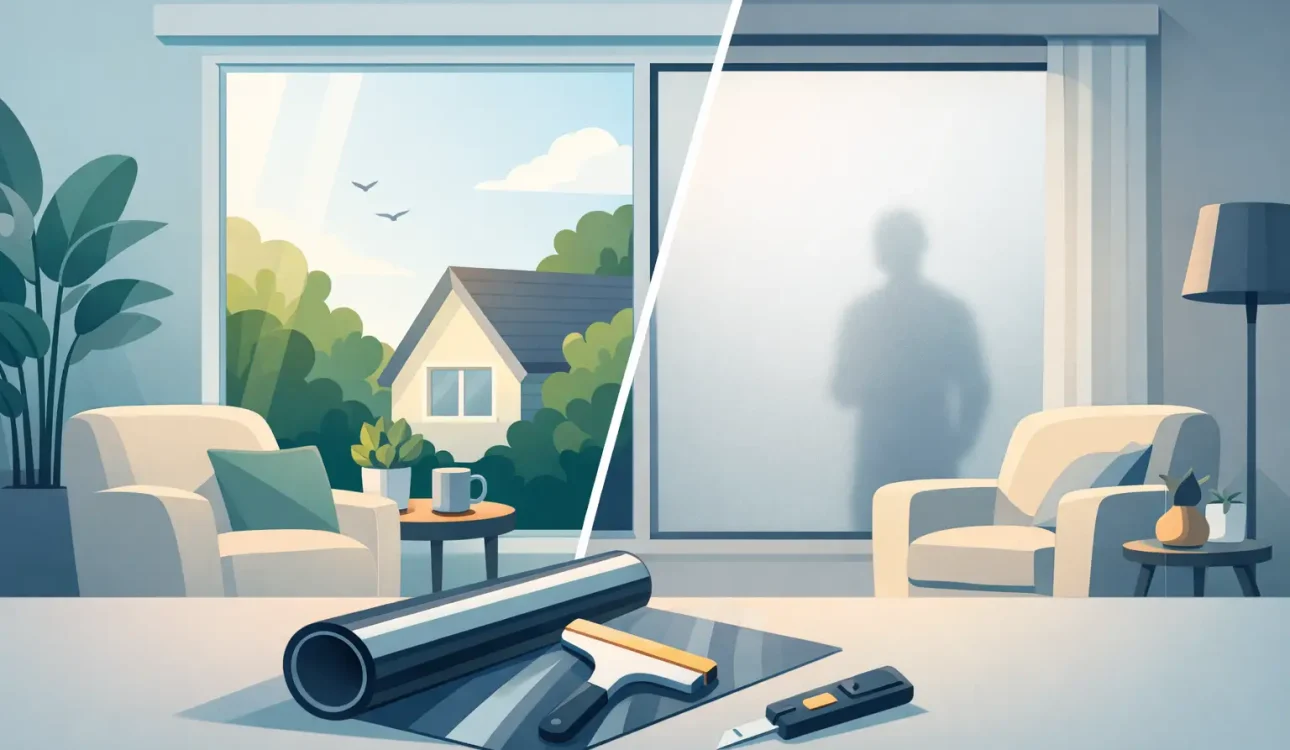
If your priority is consistent privacy both day and night, frosted film is often the safest answer. It obscures visibility from both sides while still allowing natural light to pass through. That makes it especially popular for bathrooms, entryway panels, office partitions, clinic rooms, and ground-floor windows where direct sightlines are the main problem.
The biggest advantage of frosted film is predictability. It does not depend on lighting conditions the way one-way reflective film does. Whether it is noon or after dark with interior lights on, the glass remains screened.
The trade-off is that you lose a clear view out. Frosted film is for privacy first, not visibility. If you want to maintain your outlook while reducing inward visibility, this may feel too closed off for living rooms or scenic windows.
For many homes, frosted film is the best window film for privacy in rooms where function matters more than view. It delivers a clean, modern look and works well on both residential and commercial glass.
Reflective film – strong daytime privacy with added solar control
Reflective film is a common choice for people who want privacy without fully blocking the outside view. During the day, it creates a mirror-like exterior effect that makes it harder for people outside to see in, while those inside can usually still see out.
This type of film is especially useful on sun-exposed windows because it can also reduce glare and help reject solar heat. For homes and offices with harsh afternoon sun, that dual benefit can be a major advantage.
However, reflective film has one important limitation – nighttime privacy is different. Once interior lighting becomes stronger than exterior light, the effect can reverse, and people outside may be able to see in. That does not make reflective film a poor product. It just means it is best for daytime privacy, not 24-hour screening.
For street-facing condos, offices, and upper-floor units with strong daylight exposure, reflective film can be an excellent fit. But if the room is heavily used at night and privacy remains critical after sunset, you may need curtains, blinds, or a different film type.
Blackout film – maximum privacy, minimum light
When absolute privacy is more important than daylight, blackout film is the strongest option. It blocks visibility entirely and significantly darkens or fully blocks incoming light depending on the product.
This makes blackout film suitable for server rooms, storage areas, bedrooms for shift workers, AV rooms, or spaces where glare and visibility need to be eliminated rather than managed. It is also useful for covering specific glass panels where visual interruption is necessary.
The obvious downside is that it changes the room experience. You are not just stopping people from looking in. You are also reducing natural brightness and often sacrificing openness. In main living spaces, that can feel too heavy unless there is a very specific need.
So while blackout film may offer the highest privacy level, it is not automatically the best window film for privacy for everyday use. It is the best only when complete concealment is the actual requirement.
Decorative film – privacy with a design element
Decorative film sits somewhere between function and style. It includes patterned, gradient, textured, and custom-cut options that can obscure views partially or fully depending on the design.
This category is popular in offices, retail settings, and modern homes that want privacy without a plain frosted finish. It can break up sightlines while adding visual interest to glass doors, conference rooms, partitions, or feature panels.
The key point here is that decorative film varies widely. Some designs are highly private. Others are more aesthetic than practical. If privacy is your main concern, choose the pattern after confirming how much visibility it actually blocks.
How to choose the right privacy film for your space
The best choice usually comes down to three questions.
First, do you need privacy during the day, at night, or all the time? If the answer is all the time, frosted or blackout film is usually more reliable than reflective film.
Second, do you want to keep your outside view? If yes, reflective film may be the better fit for daytime conditions. If no, frosted film often gives a more balanced result with natural light still coming through.
Third, is heat control also a problem? In warmer climates and high-sun areas, privacy should not be considered in isolation. A film that also reduces heat gain and glare can improve comfort and help support lower cooling demand. That is often a better long-term investment than choosing a basic privacy-only option.
Window orientation matters too. West-facing glass, low-floor units, street-level windows, and buildings with close neighboring blocks all create different privacy challenges. The film that works beautifully in a bathroom may be completely wrong for a living room or storefront.
Why installation quality matters more than most people expect
Even the best film will disappoint if it is poorly installed. Bubbles, edge lift, dust contamination, uneven alignment, and early peeling can all affect both appearance and performance. Privacy film is highly visible by nature, so mistakes tend to stand out.
Professional installation also helps ensure the right film is matched to the glass type and environment. This is especially important for large panels, older glazing, or spaces where solar absorption and compatibility need to be considered carefully.
An experienced supplier will usually ask better questions before making a recommendation. They will look at privacy needs, sun exposure, viewing angles, and usage patterns instead of simply suggesting the darkest or cheapest product.
That is where a specialist approach makes a difference. Companies like ShieldShade International focus on matching film performance to real residential and commercial conditions, which is exactly what customers need when privacy, heat, and aesthetics all have to work together.
Common mistakes when comparing privacy films
One common mistake is assuming darker means more private. Dark tint can reduce visibility, but it does not always provide the kind of screening people expect, especially at night.
Another is choosing based on appearance alone. A reflective finish may look sleek from outside, but if nighttime privacy is your priority, it may not solve the full problem.
Price-only decisions can also backfire. Lower-grade films may fade, bubble, or underperform under strong sun. Privacy film is not just a surface treatment. It is part of how a room feels and functions every day.
The better approach is to compare by use case. Ask what the room needs, when privacy matters most, and what compromises are acceptable. That usually leads to a much smarter decision than simply asking which film is most popular.
The best window film for privacy is the one that fits how you actually use the space. For full-time screening with soft natural light, frosted film is hard to beat. For daytime privacy with heat and glare reduction, reflective film is often a strong choice. For total concealment, blackout film does the job. And for style-led spaces, decorative film can offer a more customized balance.
If you start with the room, not the product label, the right answer becomes much clearer. Upgrade your view with a film that gives you privacy without creating new compromises.