
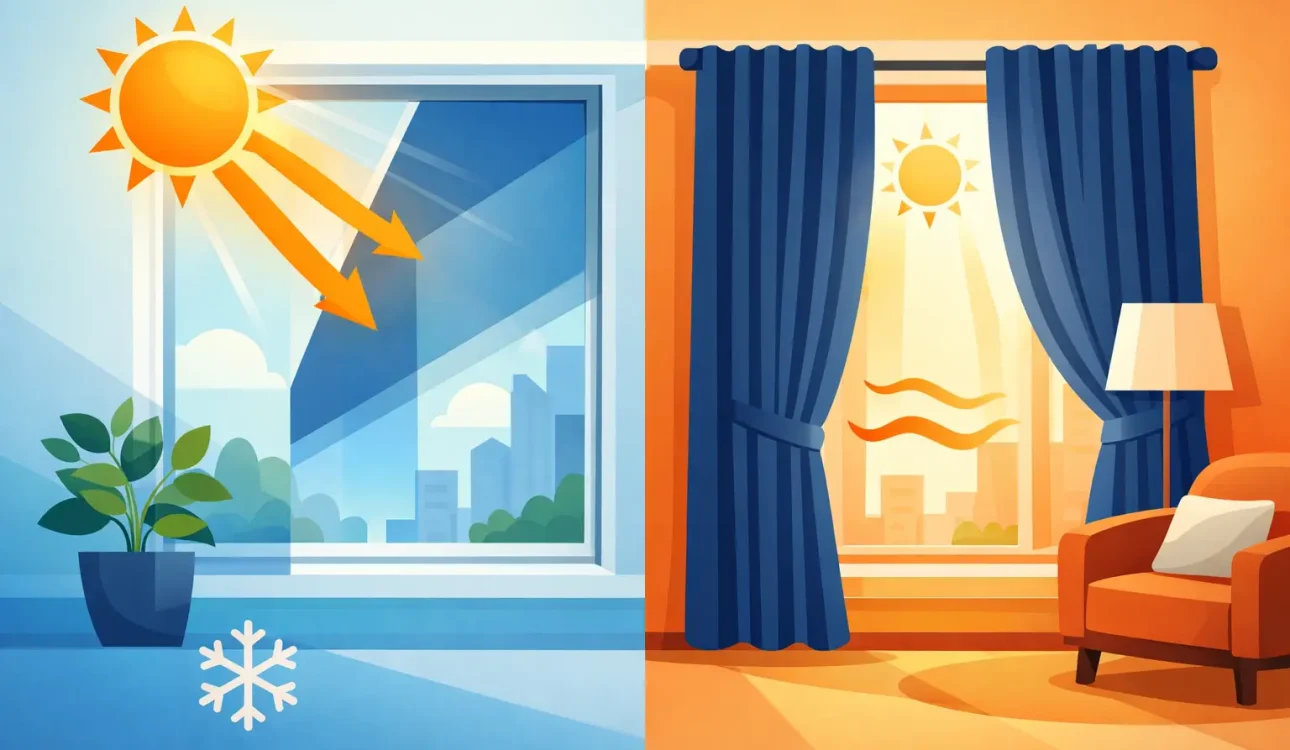
A west-facing living room can look beautiful at 4 p.m. and feel unbearable by 4:30. When comparing solar film vs curtains, the real question is not which window treatment looks better. It is which one solves the problem you actually live with: heat trapped near the glass, harsh screen glare, fading furnishings, overlooked rooms, or a need for darkness.
Curtains remain a familiar choice because they add softness and visual warmth. Solar film takes a different approach. Applied directly to existing glass, it is designed to manage sun before it spreads through the room. For homes, apartments, offices, and retail spaces with strong sun exposure, that difference can affect comfort every day.
Solar Film vs Curtains: The Core Difference
Solar film is a thin, professionally applied layer that changes how glass handles solar energy. Depending on the film selected, it can reject a significant portion of heat, reduce glare, block UV exposure, and maintain a clear outward view. It works while the window remains uncovered.
Curtains work as an interior barrier. They can reduce perceived heat and block light when drawn, especially when they are lined or made with blackout material. However, sunlight has already passed through the glass by the time it reaches the curtain. The window, air gap, and fabric can still absorb and release heat into the room.
That does not make curtains ineffective. It simply means they are better suited to some goals than others. If you want an adjustable decorative feature and full darkness on demand, curtains are highly useful. If you want continuous daytime heat and glare control without closing off the view, solar film is usually the stronger solution.
Heat Control: Where Solar Film Has the Advantage
In sunny climates, bare glass can be one of the largest sources of heat gain in a room. This is especially noticeable on broad windows, high-rise units, rooms facing the afternoon sun, and offices with glass partitions or exterior glazing.
Solar film is built to reduce the amount of solar heat transmitted through the glass. Performance varies by film type, glass type, window orientation, and color or reflectivity of the chosen film. A high-performance film can make a room feel less punishing near the window and may reduce the load placed on air conditioning.
Curtains can help when they are fully closed, but the result depends on fabric thickness, lining, fit, and whether gaps allow sunlight to enter. Light-colored or sheer curtains offer limited heat control. Heavy blackout curtains perform better, but they also turn the window into a closed wall during the day.
For rooms that are hot from morning to evening, film is often the practical first upgrade. For bedrooms that only need occasional light blocking, curtains may be enough. In many homes, the best answer is both: solar film for everyday heat rejection and curtains for added darkness or insulation when needed.
Glare and Daytime Visibility
Glare is not always obvious until you try to work at a laptop, watch television, or hold a video call beside a bright window. Curtains can eliminate glare when closed, but they also remove daylight and outside visibility.
Solar film reduces harsh brightness while preserving a more open room. This is particularly useful for living rooms, home offices, reception areas, meeting rooms, and storefronts where natural light is welcome but direct sunlight is disruptive. The right shade should be selected carefully. A film that is too dark can make an already shaded room feel dim, while a lighter neutral film can reduce glare with a more subtle appearance.
For office managers, this balance matters. Employees often prefer natural light, but not reflected glare on monitors. Solar film supports a more usable daylight environment without requiring staff to adjust blinds throughout the day.
UV Protection and Furniture Fading
Sunlight can gradually damage flooring, artwork, upholstery, wood finishes, and merchandise near windows. Curtains provide some protection only where the fabric physically covers the window and only when they are drawn. Any uncovered glass continues to admit UV exposure.
Quality solar films are designed to block the vast majority of ultraviolet rays. This makes them a strong long-term choice for rooms with valuable furniture, display areas, or interiors finished in materials that can fade under persistent sun exposure. UV reduction does not stop all fading, since visible light and heat also play a role, but it is an important layer of protection.
If preserving your interior is a priority, a solar film consultation should account for the window’s direction, the amount of direct sun, and the items positioned closest to the glass.
Privacy: Curtains Offer Control, Film Offers Consistency
Curtains provide immediate privacy when closed. They are an effective solution for bedrooms, changing areas, and rooms where complete visual separation is required. Their limitation is simple: closing them for privacy also closes off the view and daylight.
Privacy window films can offer a more consistent daytime solution. Frosted film obscures visibility on glass panels and is well suited to bathrooms, office partitions, entry sidelights, and interior rooms. Reflective or one-way films can increase daytime privacy on exterior windows, particularly when it is brighter outside than inside.
There is an important trade-off with reflective film: it does not provide the same one-way effect after dark when interior lights are brighter than outdoors. Curtains or blinds are still needed for nighttime privacy in most residential settings. A reliable installer should explain this clearly rather than treating one-way film as a 24-hour privacy guarantee.
Style, Space, and Maintenance
Curtains are a design element. They add texture, color, softness, and visual height to a room. For homeowners who want a layered interior or a hotel-inspired bedroom, they can be central to the look.
Solar film is more understated. It keeps the glass line clean and does not take up wall space, collect as much dust, or interfere with furniture placed near windows. That can be a major advantage in compact apartments, modern condos, clinics, offices, and retail spaces where a minimal finish is preferred.
Maintenance is also different. Curtains require periodic washing or dry cleaning, depending on the fabric. Solar film is generally maintained by cleaning the glass with suitable non-abrasive methods once the installation has fully cured. Both can be durable, but film quality and installation precision are critical. Poorly installed film may bubble, peel, or appear uneven, while low-grade curtains may fade or lose shape over time.
Cost Should Be Judged Over the Life of the Solution
Curtains range from inexpensive ready-made panels to custom-made treatments with tracks, lining, and professional installation. The final price can rise quickly for large windows, tall ceilings, motorized systems, or premium fabrics.
Solar film pricing depends on the glass area, film performance level, accessibility, existing glass condition, and installation requirements. It is not just a material purchase. It is a window-performance upgrade that should be matched to the room’s use and sun exposure.
A lower-cost film is not automatically the better value if it provides weak heat rejection, distorts the view, or does not carry suitable warranty support. Likewise, a dark film is not necessarily the best heat-control choice. Modern premium films can deliver strong performance in lighter shades, preserving more natural light and a more neutral appearance.
For existing windows, film is often far less disruptive than replacing glass. This makes it a practical option for property owners seeking comfort improvements without a major renovation.
When to Choose Solar Film, Curtains, or Both
Choose solar film when your main concern is daytime heat, glare, UV exposure, or maintaining visibility through sun-exposed windows. It is especially effective for living rooms, kitchens, home offices, commercial spaces, and large glass facades.
Choose curtains when full darkness, flexible privacy, decorative impact, or a softer interior finish is the priority. Blackout curtains remain a sensible choice for bedrooms, nurseries, and media rooms.
Choose both when a room experiences intense sunlight and also needs nighttime privacy or sleep-friendly darkness. Film handles daytime solar performance; curtains provide the final layer of light control and comfort after sunset.
Before selecting either option, consider the window orientation, the room’s purpose, your building rules, and whether the glass is single-pane, double-pane, laminated, or tempered. These details influence film compatibility and the result you can expect. An experienced specialist such as ShieldShade International can assess the glass and recommend a film grade that fits the space instead of applying a one-size-fits-all solution.
Your windows should let you enjoy the view without forcing you to accept the heat, glare, or lack of privacy that comes with it. Start with the problem you want solved, then choose the window treatment that continues working when you need it most.